

Make Soft Eggless Donuts at Home, Fried or Baked, Plus a Quick Box Mix
Yeasted, fried dough gives you the closest match to a classic bakery donut, with a light, airy crumb. A no‑yeast baked batter gets you there in under an hour, with a softer, cakier bite and no oil required. Choose the fried version for texture and occasion baking, the baked version for speed, and a ready mix like Missy Lala’s Cook Islands Donut Baking Mix when you just want reliable results without measuring nine ingredients.
TL;DR:
- Yeasted fried donuts develop their airy texture through gluten development and proper proofing, not from eggs, which mostly add richness.
- The no‑yeast baked batter relies on baking powder and soda activated by a milk‑and‑vinegar mixture to create a fluffy, tender donut in under 40 minutes.
- Proper proofing, correct oil temperature, and avoiding overmixing are key to preventing dense, greasy, or flat donuts, whether fried or baked.
- Using premade donut mixes can save time and ensure consistent results, especially for quick weekday baking or those with dietary restrictions.
- Both fried and baked eggless donuts can be customized with glazes, cinnamon sugar, or fillings, and ingredient swaps allow for dairy-free, vegan, or gluten-free versions.
Table of Contents
- Yeasted eggless donuts: the classic fried recipe
- No‑yeast baked eggless donuts: the quick batter method
- Glazes, cinnamon sugar, and finishing touches
- Ingredient swaps for dairy‑free, vegan, and gluten‑free bakers
- Why your donuts turned out dense, oily, or flat (and how to fix it)
- When to bake from scratch and when to reach for a mix
- Missy Lala’s Cook Islands Donut Baking Mix, from bag to plate
- Sources
- FAQ
Yeasted eggless donuts: the classic fried recipe
Fried donuts get their pillowy texture from gluten development and a proper proof, not from eggs. Eggs mostly add richness and a bit of structure, both of which you can recover with the right ratio of fat, milk, and yeast. This recipe follows the same logic used in Raks Kitchen’s eggless doughnut method, which relies on instant dried yeast and standard dough handling to get an airy, fried texture without a single egg.
Ingredients (makes 10-12 donuts)
- 500g plain flour
- 60g caster sugar
- 7g instant dried yeast (about 2 teaspoons)
- 5g salt
- 250ml lukewarm milk (dairy or plant based)
- 50g melted unsalted butter or neutral oil
- Vegetable oil for frying (about 1 litre)
Method
Warm the milk to around 37 to 40°C. It should feel like a warm bath on your wrist, not hot. Anything hotter than 45°C will kill the yeast before it gets a chance to work. Stir in a teaspoon of the sugar and the yeast, then leave it for 8 to 10 minutes until it turns foamy on top. If nothing happens, your yeast is dead and you need a fresh sachet.
Combine the flour, remaining sugar, and salt in a large bowl. Pour in the yeast mixture and melted butter, then bring it together into a rough dough. Knead for 8 to 10 minutes by hand, or 5 minutes on a stand mixer, until the dough is smooth, slightly tacky, and springs back when poked. Avoid over‑kneading. Donut dough needs less gluten development than bread, so once it’s smooth, stop.
Cover the bowl and leave it somewhere warm for 60 to 90 minutes, until the dough has roughly doubled. You’re looking for a dough that holds a dimple when you poke it gently, springing back slowly rather than snapping shut.
Turn the dough out onto a lightly floured surface and roll it to about 1.5cm thick. Cut rounds with a donut cutter or two differently sized glasses. Reroll the scraps once, but no more. Overworked scraps make tough donuts.
Place the shaped donuts on baking paper, cover loosely, and proof for another 30 to 40 minutes until visibly puffy. This second proof is where a lot of home bakers get impatient and skip ahead. Don’t. Under-proofed donuts turn dense and doughy in the centre even when the outside looks golden.
Heat oil to 170 to 175°C. A kitchen thermometer is worth the $10 here. Too hot and the outside browns before the inside cooks; too cool and the donuts soak up oil and turn greasy. Fry two or three at a time until golden brown on both sides, usually a few minutes per side, until deep golden brown. Drain on paper towel or a wire rack immediately.
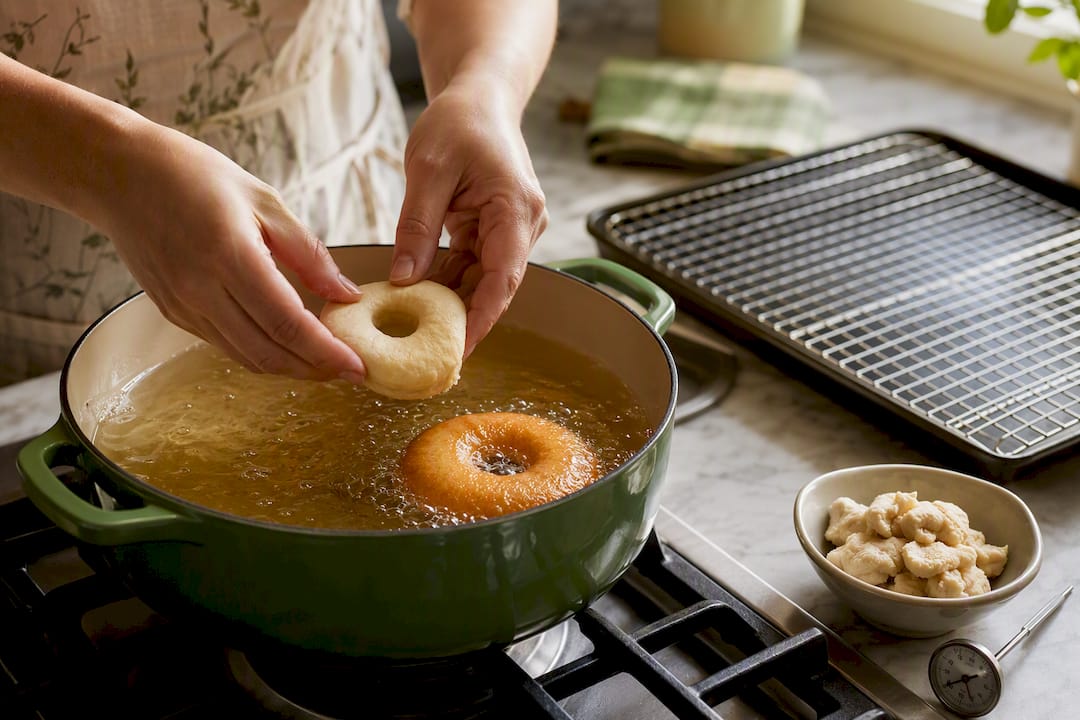
Pro Tip: Test your oil with a small offcut of dough before frying the whole batch. If it sinks and doesn’t rise within a few seconds, the oil isn’t hot enough yet.
Once cooled slightly, they’re ready for glaze or cinnamon sugar, both covered below. Fried eggless donuts are best eaten the day they’re made, though they’ll keep in an airtight container at room temperature for a day, or in the fridge for up to three days.
No‑yeast baked eggless donuts: the quick batter method
Skip the proofing entirely and you can have warm donuts on the table in under 40 minutes. Baked donuts rely on baking powder and baking soda for lift instead of yeast, and a simple milk‑and‑vinegar “buttermilk” to activate the soda and tenderise the crumb. Bake with Shivesh’s no‑yeast eggless donut recipe uses exactly this combination to get a fluffy result without a single rise.
Ingredients (makes 6-8 donuts, standard donut pan)
- 200g plain flour
- 100g caster sugar
- 1½ teaspoons baking powder
- ½ teaspoon baking soda
- Pinch of salt
- 180ml milk, dairy or plant based
- 1 tablespoon white vinegar or lemon juice
- 60g melted butter or neutral oil
- 1 teaspoon vanilla extract
Method
Stir the vinegar into the milk and let it sit for 5 minutes. It will thicken slightly and curdle a little, which is exactly what you want. This DIY buttermilk reacts with the baking soda to create lift and a slightly tangy, tender crumb, standing in for the acidity eggs would normally bring.
Whisk the flour, sugar, baking powder, baking soda, and salt together in one bowl. In another, combine the buttermilk, melted butter, and vanilla. Pour the wet mixture into the dry and stir with a spatula until just combined. Small lumps are fine. Overmixing develops gluten and gives you tough, rubbery donuts instead of soft ones.
Grease a donut pan well, including the centre posts. Spoon the batter into a piping bag or a zip‑lock bag with the corner snipped off, and pipe it evenly into each cavity, filling to about three quarters full. Bake at 180°C until a skewer comes out clean, about 12 to 15 minutes, a timing consistent with Mommy’s Home Cooking’s eggless baked donut recipe, until a skewer comes out clean and the tops spring back when touched.
Leave the donuts in the pan briefly before turning them out onto a wire rack. Eggless baked batters are delicate straight out of the oven, and pulling them out too soon risks tearing or collapsing the shape.
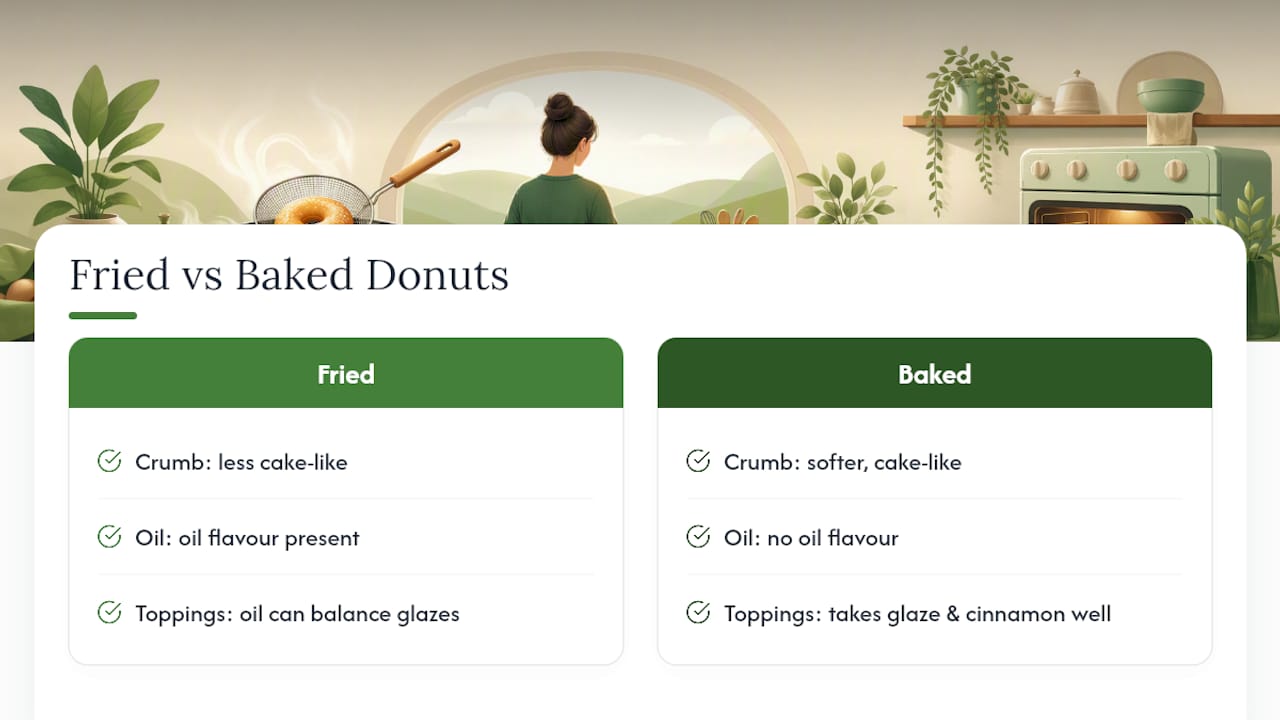
Baked donuts have a softer, more cake‑like crumb than their fried cousins. There’s no oil flavour to balance out, so they take glaze and cinnamon sugar particularly well, and they’re a genuinely easier entry point if you’ve never made a donut recipe without eggs before.
Glazes, cinnamon sugar, and finishing touches
A good glaze or coating turns a plain eggless donut into something that looks and tastes like it came from a bakery counter. Timing matters more than most people expect here.
- Chocolate glaze: melt 100g dark chocolate with 30g butter and 2 tablespoons milk over a double boiler, then stir in 100g icing sugar until glossy. Dip donuts once fully cooled.
- Vanilla glaze: whisk 150g icing sugar with 2 to 3 tablespoons milk and ½ teaspoon vanilla until smooth and pourable. Dip or drizzle over cooled donuts.
- Cinnamon sugar: mix 100g caster sugar with 1½ teaspoons ground cinnamon. Brush warm donuts (fried or baked) with melted butter, then toss straight into the sugar while they’re still warm, so it sticks properly.
- Jam or custard filling: use a piping bag fitted with a narrow round nozzle, poke it into the side of a cooled donut, and squeeze gently until you feel slight resistance and a little filling peeks out.
- Decoration: sprinkles, shredded coconut, or crushed nuts stick best to glaze that’s still slightly tacky, within the first minute or two of dipping.
One rule that trips people up: glaze goes on cooled donuts, cinnamon sugar goes on warm ones. Glazing a hot donut makes it slide straight off; sugaring a cold one won’t stick at all. For transport, layer donuts in a single layer in a shallow container rather than stacking them, since glazed tops smudge easily against each other.
Ingredient swaps for dairy‑free, vegan, and gluten‑free bakers
Both recipes above adapt easily, and none of the swaps require specialty ingredients you can’t find at a regular supermarket.
- Dairy‑free: swap butter for a plant‑based block butter or a neutral oil like canola or rice bran oil, and use oat, soy, or almond milk in place of dairy milk. Oat milk gives the closest result to dairy in terms of richness.
- Buttermilk substitute: any plant milk plus a tablespoon of vinegar or lemon juice works the same way as dairy buttermilk, though soy milk curdles most reliably.
- Vegan overall: the yeasted and baked recipes above are already egg‑free, so making them fully vegan is mostly a matter of the butter and milk swaps listed here.
- Flax or chia “egg” replacers: these aren’t needed in either recipe here, since lift comes from yeast or baking powder rather than egg binding, but a tablespoon of ground flax mixed with three tablespoons of water can add extra structure if you’re troubleshooting a particularly delicate batter.
- Gluten‑free: a 1:1 gluten‑free flour blend works reasonably well in the baked version, along the lines of the approach The Allergy Chef’s gluten‑free eggless donut recipe takes, though expect a slightly denser, more delicate crumb. Gluten‑free yeasted dough is much harder to get right at home and isn’t recommended for beginners.
Why your donuts turned out dense, oily, or flat (and how to fix it)
Most donut failures trace back to one of three things: temperature, mixing, or leavening balance, and each has a specific fix rather than a vague “try again.”
Dense, doughy centres usually mean under‑proofing, not a bad recipe. If your yeasted dough hasn’t visibly puffed during the second proof, it hasn’t finished rising, and frying won’t fix that. Give it another 15 minutes in a warm spot before you go anywhere near the oil.
Oily, greasy donuts point to oil that’s too cool. At below 165°C, dough absorbs oil instead of sealing quickly, which is why a thermometer matters more than eyeballing “shimmering oil.” If your oil drops in temperature after adding a couple of donuts, which it will, let it recover before adding more.
Flat, dense baked donuts almost always come down to leavening or overmixing. Baking soda needs an acidic ingredient like the vinegar‑milk buttermilk to activate; skip that and your donuts won’t lift properly no matter how much baking powder you add. Overmixing the batter develops gluten too early, which fights against the leavening and gives you a tough, flat result instead of a tender one, a point echoed across most eggless baked donut recipes. Mix only until the flour disappears.
Pro Tip: If your baked donuts consistently sink slightly in the middle after baking, pull them from the oven a minute earlier next time and let them finish setting in the residual heat of the pan.
If measuring nine ingredients and testing oil temperature isn’t how you want to spend a Sunday, a premade donut baking mix removes most of the leavening guesswork, since the balance is already set. Even with a premix, a few small habits lift the result: resting the batter for five minutes before piping lets the flour hydrate properly, and a splash of extra milk if the batter looks too thick helps avoid dense edges. Missy Lala’s own guide on improving box donut mix covers several of these small adjustments in more detail, and the mastering doughnut baking mix guide goes further into handling technique.
- Rest batter 5 minutes before shaping to hydrate the flour fully.
- Add a splash of extra milk if batter looks stiff, rather than more oil.
- Don’t overfill the pan or piping bag, since donuts need room to rise.
- Check your oven’s actual temperature with a separate thermometer if bakes seem inconsistent.
When to bake from scratch and when to reach for a mix
Baking from scratch makes sense when you’ve got the time and want full control over flavour, whether that’s a stronger vanilla note or a specific glaze. It’s also genuinely satisfying to prove you can get a soft, properly risen donut without a single egg in the bowl.
But most weeknights aren’t built for proofing dough twice. That’s where a mix earns its place, particularly for family baking sessions where the goal is getting kids involved and donuts on a plate, not perfecting technique. It’s also the more forgiving option if you’re baking for someone with an egg allergy and don’t want to be second‑guessing every ratio.
Try both approaches at least once. You’ll learn what actually matters in a donut recipe, and you’ll know exactly when a shortcut is worth taking. Missy Lala’s Cook Islands donut story is worth a read if you want the cultural background behind the mix as well.
— Jasmin
Missy Lala’s Cook Islands Donut Baking Mix, from bag to plate
If everything above sounds like more steps than your Tuesday night has room for, Missy Lala’s Cook Islands Donut Baking Mix is the shortcut that skips the ingredient list entirely. It’s an egg‑free mix that needs only water and oil, and it gives you consistent, soft donuts without weighing out flour or worrying whether your yeast is still alive.
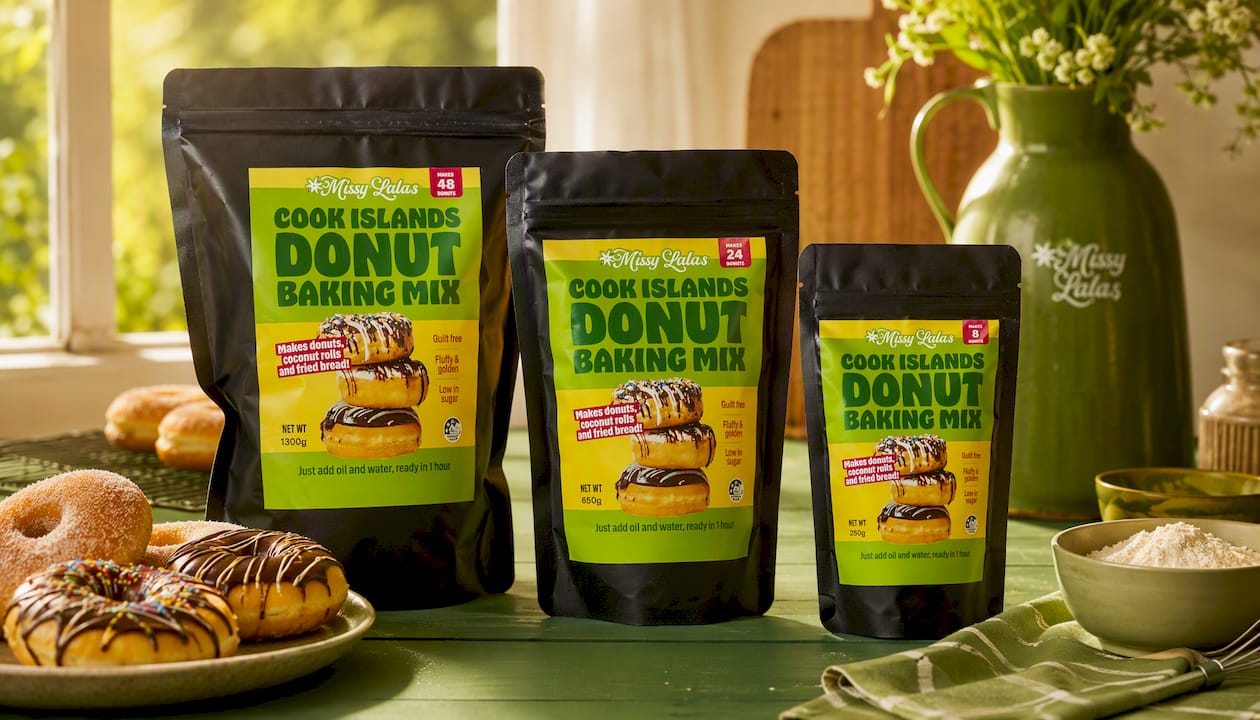
The mix comes in three sizes depending on how often you bake and who you’re feeding. The 250g pack suits a single batch or a first try before committing to a bigger bag. The 650g pack is the practical option for a family that bakes regularly, generally enough for a couple of batches. The 1300g pack suits gatherings, school events, or households who go through donuts fast enough to want less packaging and fewer reorders.
Because the mix only needs water and oil, many bakes come together in under an hour from mix to warm donut, without any of the temperature‑checking or proofing timing covered above. If you want to push the results further, the box mix improvement guide walks through small adjustments that lift texture even more. Pick a pack size and get baking.
Sources
- No Yeast Eggless Donut Recipe – Fluffy & Tasty | Bake with Shivesh
- Easy Chocolate Eggless Donut Recipe: No Yeast, Baked Donuts | The Allergy Chef™
- Easy Eggless Baked Donuts - Mommy’s Home Cooking
- Eggless doughnut recipe, Basic donut, soft & light | Raks Kitchen
FAQ
Are any donuts made without eggs?
Yes. Both classic yeasted, fried donuts and quick baked donuts can be made entirely without eggs, using yeast or baking powder and soda for lift instead.
Which donut does not have eggs?
Any donut recipe that replaces eggs with extra leavening, like baking powder and soda, or relies on yeast and gluten development for structure, works without eggs. This includes most classic ring donuts, cake donuts, and baked donut‑pan versions.
What can I use instead of eggs in doughnuts?
A milk‑and‑vinegar buttermilk combined with baking soda replaces the lift and tenderness eggs usually provide, while extra fat like melted butter or oil adds back richness.
How do you make eggless doughnuts?
For fried donuts, proof a yeasted dough twice, shape it, and fry at 170 to 175°C until golden. For baked donuts, mix a buttermilk‑based batter, pipe it into a donut pan, and bake at 180°C for 12 to 15 minutes. A premix like Missy Lala’s Cook Islands Donut Baking Mix simplifies both routes into a single water‑and‑oil method.


