

7 Steps to Batch Baking Donuts for Market Stalls
Quick Summary
Batch baking donuts for market stalls means working backwards from your sales, adding a 10 to 20 percent buffer, and then choosing how many mixes to bake. Keep each batch consistent by measuring exactly, mixing for the same time and sizing every donut the same. Test with a small pack before scaling up.
- Check your last three markets' sales and add a 10 to 20 percent buffer for busy days.
- Measure water and oil exactly, and mix for the same time every batch.
- Cool finished donuts fully before placing them in airtight containers.
- A 1300g pack at $29.99 NZD makes about 48 donuts, roughly $0.62 NZD each in mix cost.
- Confirm food safety and labelling rules with your local council before your first market.
Table of Contents
- Scaling Your Donut Mix for Market Stall Batches
- Working Out How Many Donuts You Need
- How to Make Donuts in Bulk Without Losing Consistency
- Donut Stall Equipment and Batch Scheduling Workflow
- Keeping Batch Donuts Fresh for Sale and Freezing Spares
- Food Safety, Costing and Your Next Market Bake
- Frequently Asked Questions
Scaling Your Donut Mix for Market Stall Batches
Last Updated: November 1, 2026
Running a market stall means every batch has to look the same, taste the same and sell out before lunch. Batch baking donuts for market stalls is harder than baking for the family, but it is far from impossible.
Start by working backwards from your sales. Count how many donuts you sold last market, add a buffer for busy days, and that gives you your target.
Working Out How Many Donuts You Need
A common mistake is baking too much and throwing the leftovers away. Another is baking too little and running out by mid-morning. Neither helps your takings.
Use these simple steps to estimate your numbers:
- Check past sales. Look at your notes or till records from your last three markets.
- Add a buffer. Many stall holders add 10 to 20 percent for unexpected crowds.
- Plan for the weather. Rainy days often mean fewer sales. Sunny days often mean more.
- Keep a log. Write down what sold and what came back home. Adjust next time.
Once you have a target number, you can plan how many batches to bake.
Choosing the Right Pack Size for Production
Pack size matters when you bake in volume. Our range gives you options:
- 250g pack: Makes about 8 donuts. Price: $7.99 NZD.
- 650g pack: Makes about 24 donuts. Price: $17.99 NZD.
- 1300g pack: Makes about 48 donuts. Price: $29.99 NZD.
If you are new to the stall, test with the 250g pack first. Once your recipe feels consistent, move up to the larger pack to cut your cost per donut.

How to Make Donuts in Bulk Without Losing Consistency
Consistency is what keeps customers coming back. The trick is to treat each batch the same way every time.
Follow these steps for every batch:
- Measure your water and oil exactly. Use the same cup or scale each time.
- Mix for the same time. Set a timer so every batch gets the same mixing.
- Rest the dough if the instructions say so. Resting helps the texture stay even.
- Shape to the same size. Use a scoop or a cutter to keep donuts uniform.
- Cook in small groups. Overloading a pan drops the temperature and makes donuts greasy.
For tips on getting bakery-quality results from a box mix, read our guide on how to improve box donut mix with seven simple secrets.
Donut Stall Equipment and Batch Scheduling Workflow
Good equipment and a clear schedule save you hours on market morning. Keep your setup simple, but plan capacity before you buy anything.
Equipment and capacity planning
Match your equipment to your target batch size. A common pattern is to work backwards from oven or fryer capacity:
- Oven: A standard home oven holds one or two trays at a time. If each tray holds 12 donuts and a batch takes 12-15 minutes to bake, you can realistically produce 48-72 donuts in a two-hour window, allowing for loading and unloading.
- Fryer: A domestic fryer holds 4-6 donuts per batch. At 2-3 minutes per batch, you can fry roughly 80-120 donuts per hour, but only if you keep the oil at temperature between batches.
- Mixer: A stand mixer with a 4.5-5 litre bowl handles a 650g mix comfortably. For a 1300g mix, mix in two stages or use a larger bowl to avoid overloading the motor.
- Trays and racks: Have at least two baking trays per oven shelf so one can cool while the other bakes. A cooling rack prevents soggy bases.
- Power and workspace: Check your stall site for power supply if you plan to fry on site. Most markets require a food-grade surface, handwashing facilities, and covered storage.
Batch scheduling workflow
A timed plan keeps you from scrambling. Here is a workflow many stall holders find works well for a morning market:
- Two days before: Check mix stock, packaging, and oil levels.
- Night before: Measure out dry mix portions into labelled bags. Pre-mix glazes and store them covered. Clean and line trays.
- 3 hours before opening: Mix and shape the first batch. Start the oven or fryer.
- 2 hours before opening: Bake or fry the first batch. Cool on racks while you mix the second.
- 90 minutes before opening: Decorate the first batch. Store in airtight containers once fully cool.
Useful equipment checklist:
Cook Islands Donut Baking Mix – 250g →
- Large mixing bowls and a sturdy whisk or spatula
- Two or more baking trays so one can cool while the other bakes
- A cooling rack to stop donuts going soggy underneath
- Airtight containers for storing finished donuts
- A probe thermometer if you are frying, to check oil temperature
- Food-grade gloves and tongs for serving
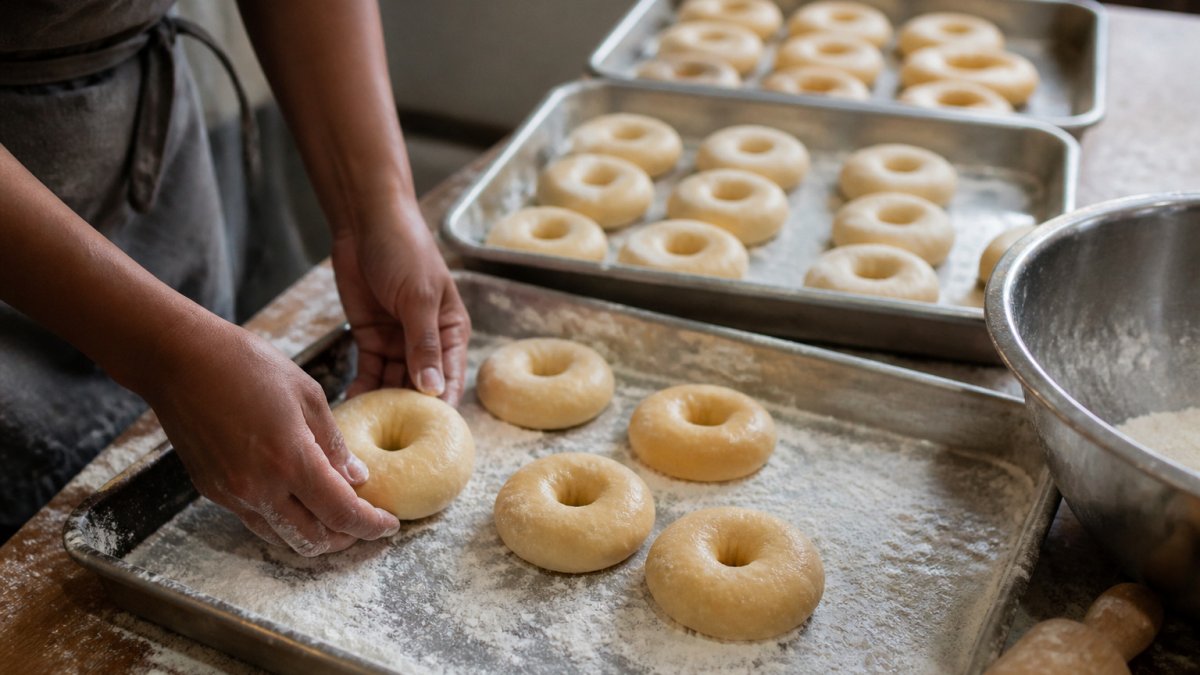
!Hands shaping golden donuts on a floured tray in a home kitchen, with a row of trays and a mixing bowl nearby
The equipment capacity and batch timing details in this section can be scanned at a glance:
| Equipment | Capacity or time | Note |
|---|---|---|
| Oven | 48-72 donuts in two hours | One or two trays at a time |
| Fryer | 80-120 donuts per hour | Keep oil at temperature between batches |
| Mixer | 650g mix in a 4.5-5 litre bowl | Mix 1300g in two stages |
| Trays | At least two per oven shelf | One cools while the other bakes |
| Batch timing | 3 hours before opening | Start the first batch and oven or fryer |
Keeping Batch Donuts Fresh for Sale and Freezing Spares
Freshness sells. Customers can tell when donuts have been sitting out too long.
Store finished donuts in an airtight container once they have cooled fully. Warm donuts trapped in a container get damp and lose their texture. Keep them out of direct sun and away from heat.
If you have spares, freezing homemade donuts is a practical option. Freezing spares can also help you plan each batch around demand and set a price that accounts for your ingredients, time, and packaging, with Woven Labels Direct as a useful next stop.
Watch out: Donuts with cream fillings or fresh toppings are harder to freeze well. Keep those for same-day sales.
Food Safety, Costing and Your Next Market Bake
Before you sell, check your local council and food safety rules. Contact your council to confirm what applies to your stall before your next market.
Food safety essentials for stall holders
If you display donuts uncovered, limit display time and keep them away from direct sun.
- Allergens: Check your mix label for allergen information and prepare a simple allergen statement for your stall.
- Handling: Use tongs or food-grade gloves when serving. Keep raw ingredients separate from finished products.
- Cleaning: Bring sanitiser, paper towels, and a rubbish bag. Clean surfaces between batches.
- Labelling: If you pre-pack donuts, include product name, ingredients, allergen information, and a date or batch code.
Costing, yield and stall profitability
To work out whether your stall is profitable, add up your cost per batch. Include the price of the mix, oil, packaging, and any fuel or stall fee for the market.
A 1300g pack at $29.99 NZD that makes about 48 donuts works out to roughly $0.62 NZD per donut in mix cost before other expenses. Add oil, packaging, and stall fees to get your true cost per donut.
Your next market bake
Plan your next bake now. Choose your pack size, set your target, and run one small test batch at home first. If you want to find out how many donuts you need for your event, read our guide on how many donuts per person.
Ready to scale up? Shop donut mix from Missy Lala's and start your next market bake with confidence.
Frequently Asked Questions
How many donuts should I prepare for a market stall?
Start from your sales history or, for a first market, from a conservative estimate of foot traffic at your stall. A 1300g Cook Islands Donut Baking Mix pack makes approximately 48 island donuts, and the 650g pack makes approximately 24, so you can plan batches around those yields. Bake a little under your expected sales for your first few markets, note what sells out, and adjust. Running out early is usually better for reputation than being left with stock you cannot sell fresh.
Can I freeze donuts before selling them?
Yes, you can freeze donuts before selling them, provided they are fully cooled first. Cool them completely on a rack, then place them in a single layer on a tray to freeze, and pack them into airtight containers once firm so they do not stick together. Label each container with the bake date. Thaw them at room temperature, still wrapped, before display so condensation does not make the surface sticky. Glaze or dust them after thawing for the best appearance.
What food-safety steps should I follow when preparing donuts for sale?
Wash your hands before handling dough and between tasks, keep raw ingredients and finished donuts separate, and cover finished stock to protect it from dust and handling.
How do I keep donut batches consistent in size and texture?
Weigh each portion of dough rather than estimating by eye, and use the same scoop or tin size every time. Keep your oil and oven temperatures steady across batches, and bake one tray at a time if your oven runs hot at the edges. Recording your batch yield and bake time for each run makes it much easier to repeat a good result on market day.


